Published by Highlanes Gallery
2024
REDEEMING OUR CATASTROPHES: EMPATHY LAB AND THE KANTIAN SUBLIME
At the point of writing this essay I worry that, for some, the sublime belongs to an earlier era. Exhausted over the centuries, a contemporary audience may view the sublime as a shibboleth clung to by out-of-touch scholars. Even among the scholarly community, its star may be dimming: the influential cultural theorist Sianne Ngai has argued that the sorts of aesthetic experience we encounter today are less grandiloquent than those described by either the sublime or its partner concept, the beautiful. She claims that, “in contrast to the moral and theological resonances of the beautiful and the sublime,” contemporary aesthetic experience is almost exclusively characterised by inconsequentiality, leading to her discussion of “the zany, the interesting and the cute” as the dominant aesthetic categories of our time.
However, if our aesthetic experiences are becoming more impoverished as a matter of course, it would stand to reason that our capacity to recognise the sublime has similarly declined. This suggests that more, and not less, should be written by art critics about the sublime, in order to advocate for its relevance against an unconscious cultural logic that dismisses it to death. Armed by the intuition that the sublime has more to teach us, even at this late stage, I will briefly sketch my own interpretation of Martin’s foray into this field.
The history of the sublime can be traced back to the first century C.E., to a work of ancient literary criticism by Longinus. Dedicated to the art of rhetoric, this epistle was focused on the concept of hypsos, which translates to ‘height’, ‘loftiness’, or ‘elevation’. On The Sublime was popularised in 1674 by Nicolas Boileau, a French critic who transformed hypsos into the Latinate le sublime. Given wings by this early neoclassicist, the concept spread like wildfire throughout the continent of Europe, rising to prominence in the writings of Edmund Burke and Immanuel Kant.
Kant is, in many respects, the father of modern philosophy. Challenging the authority of both rationalist and empiricist positions with a novel articulation of the conditions of experience, the sage of Königsberg forged a narrow path that would lead to an undiscovered continent: an epistemology that not only grounded knowledge in experience, but also explained the character of experience as a necessary output of the cognitive architecture installed in the human subject.
After his major treatises on epistemology, metaphysics and morality, Kant turned his meticulous eye to aesthetics, and in a short number of highly influential passages located in the Critique of the Power of Judgement, Kant explains his theory of the sublime. According to Kant’s account, everything in aesthetics revolves around pleasure: aesthetic claims are never about selecting a concept and applying it to a set of circumstances (or vice versa), they are instead a report on the subject’s affective state, in the presence of an object that seems to elicit this affectivity. When one claims that something is beautiful, one is drawing attention to the emergence of a feeling that issues from a harmonious balance of one’s cognitive faculties, which Kant names “a feeling of the promotion of life.” The sublime, however, involves a more complicated process than the beautiful: the sublime starts with pain.
According to Kant, there are two kinds of experiences that summon the sublime, or put differently, two kinds of sublime that can be experienced: the mathematical and the dynamic. In the mathematical sublime, we are exposed to infinite scale. In the dynamic, we are confronted by absolute power. In both cases, we acutely experience our own smallness and meanness, realising our insignificance as we are overwhelmed by the awesome force that stands before us.
Colin Martin’s ongoing investigation into the commercial industry of AI and advanced online technology strikes the same chord that Kant describes. Martin’s work invokes both, on the one hand, the limitlessness of data dispersed through international communication-networks, and on the other hand, the terrifying agglomeration of Big Tech’s socio-economic powerbase, which has embedded and accelerated changes in global politics, seemingly without constraint by civil or legal mechanisms. The first engenders Kant’s mathematical sublime, while the second relates to the dynamic. Given the need for brevity, I will focus on the former.
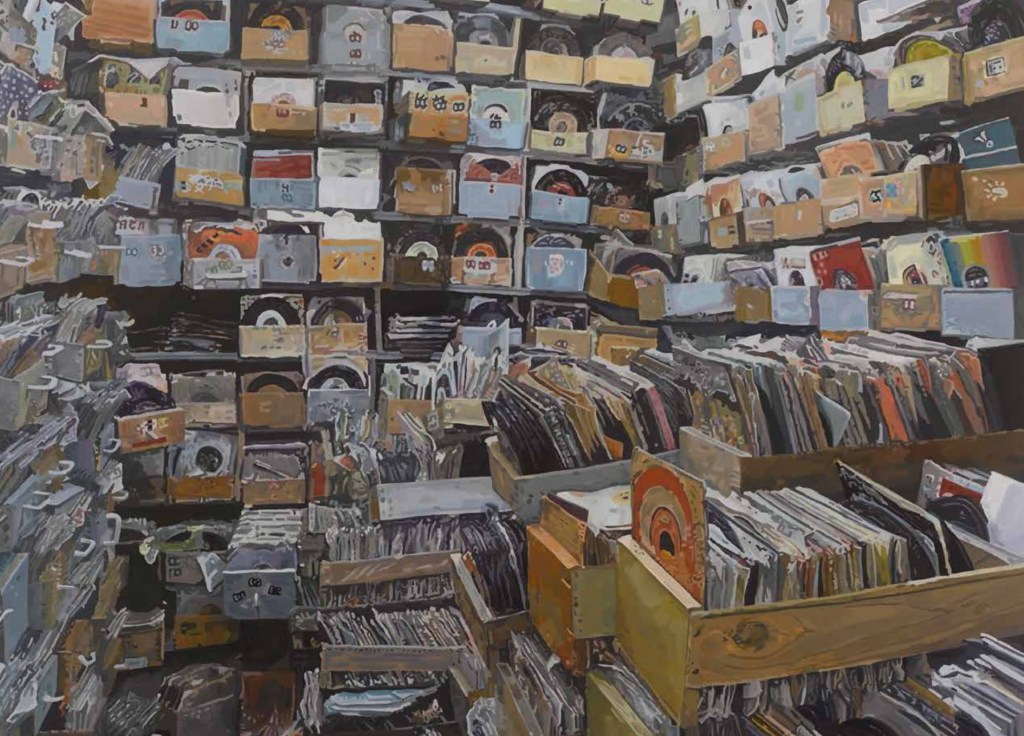
In Kant’s account of the mathematical sublime, he notes that the Egyptian pyramids and St. Peter’s Basilica in Rome both provoke the same kind of “bewilderment,” insofar as each gives the impression of containing an innumerable multitude of compositional parts. Compositional multiplicity, similarly, is a feature of Martin’s visual strategy. Take, for instance, the paintings Unreal Engine – Megacity and Fulfilment Centre. The complexity of these works is rendered by two formal properties: their resolution, namely the intricacy of detail in any given area of the surface of the image, and their depth of perspective, where the distance between foreground and background indicates the vastness of the representational field. Given these pictorial qualities, Martin’s work induces an almost palpable sense of perceptual vertigo.

Bewilderment in the face of compositional multiplicity, according to Kant, has a catalytic effect: it invokes the activity of reason. Kant’s theory of mind ascribes the functions of the mind to several cognitive modules, each of which authorise different mental states. Reason is one of the highest cognitive modules, insofar as it constructs systematic models by inference: reason takes conceptual propositions that make our immediate experience intelligible (e.g. “this apple is sweet”), and amplifies their logic into laws (e.g. “every apple is sweet”).
For Kant, reason is monstrous: this is why he dedicates his first Critique to constraining its excesses. Reason forces one to consider the set of conditions under which any item of experience emerges, and then the conditions under which those conditions emerge, and so on. This restless compulsion is the root of the mathematical sublime: when faced with an innumerable magnitude, reason’s drive to scale upwards and discover the greatest possible magnitude means that we are compelled to picture, in our imagination, infinity itself. The mind “hears in itself the voice of reason, which requires totality for all given magnitudes, even for those that can never be entirely apprehended.” Yet our capacity to picture infinity is flawed, and we find the obligation impossible to fulfil. We are pained by “the inadequacy of even the greatest effort of our imagination in the estimation of the magnitude” of this totality. Similarly, Martin’s paintings compel us to consider the conditions under which his subjects come into being, and whether it is the ultraprecise virtual model of Unreal Engine or Amazon’s cathedral-like warehouse in Fulfilment Centre, or indeed the digital currency production of Bitcoin Mine, the mathematical sublime gains traction as we attempt to comprehend the sheer scale of data required to manifest these phenomena. The heights are truly dizzying. As Sam Kriss, the London-based cultural critic, notes:
Around the turn of the century, the world contained around 50 exabytes of data: from the first Mesopotamian documents pressed into clay tablets, through five thousand years of books and pamphlets and diaries, to Shrek. Today, there’s around 65 zettabytes. A zettabyte is a thousand exabytes; an exabyte is a billion gigabytes. (Every word ever spoken by anyone who ever lived would come up to about 5 exabytes…)
The totality of data trafficked and stored in today’s communication-networks has crossed the line into the unfathomable. The magnitudes that Martin’s paintings force us to contemplate stretch our imagination to its breaking point.
And yet, as much as I have thus far stressed the role that cognitive dissonance plays in the unfolding of the sublime, I also remarked at the outset that this process was complicated. While the sublime requires the stimulant of pain to begin its heady exercise, this pain transforms into pleasure with a subtle shift in one’s meta-cognitive viewpoint. Kant again:
Because there is in our imagination a striving to advance to the infinite, while in our reason there lies a claim to absolute totality, as to a real idea, the very inadequacy of our faculty for estimating the magnitude of the things of the sensible world awakens the feeling of a supersensible faculty in us… That is sublime which even to be able to think of demonstrates a faculty of the mind that surpasses every measure of the senses.
Now we come to the value of the sublime, all too hastily sketched in this brief outline, but vital nonetheless: its essential significance is that it is the staging of a struggle at the heart of the human project.
Revealed by the proto-masochistic transformation of pain into pleasure, the sublime demonstrates that what terrifies and overwhelms us most is simultaneously our greatest source of strength. The sublime is thus a site inscribed in the territory of aesthetic experience that functions like a training ground – it processes, at a secure distance, our feelings of inadequacy in the face of primaeval forces by an aestheticised or dramaticised reappropriation.
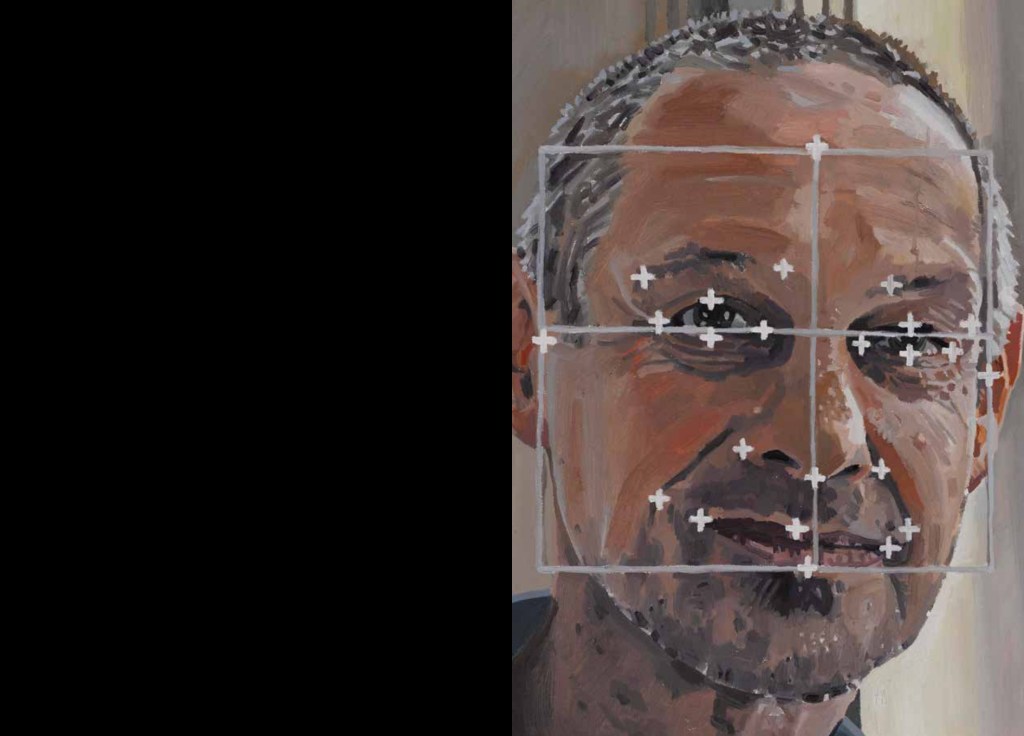
Much of Martin’s earlier output had a moving-image basis, but the fact that the experiments of the Empathy Lab programme are analogue and not digital, expressing the artist’s preoccupations through material paint pigment, strengthens the claim that there is something like a strategy of reappropriation at work. Moreover, this quasi-therapeutic function ranges beyond those subjects already referenced: Neural Lace, Neuralink, Deep Fake, and Co-Workers (Second Home) all speak to the deepest anxieties within contemporary culture that stem, in turn, from prevalent psychological experiences of dissonance and self-alienation.
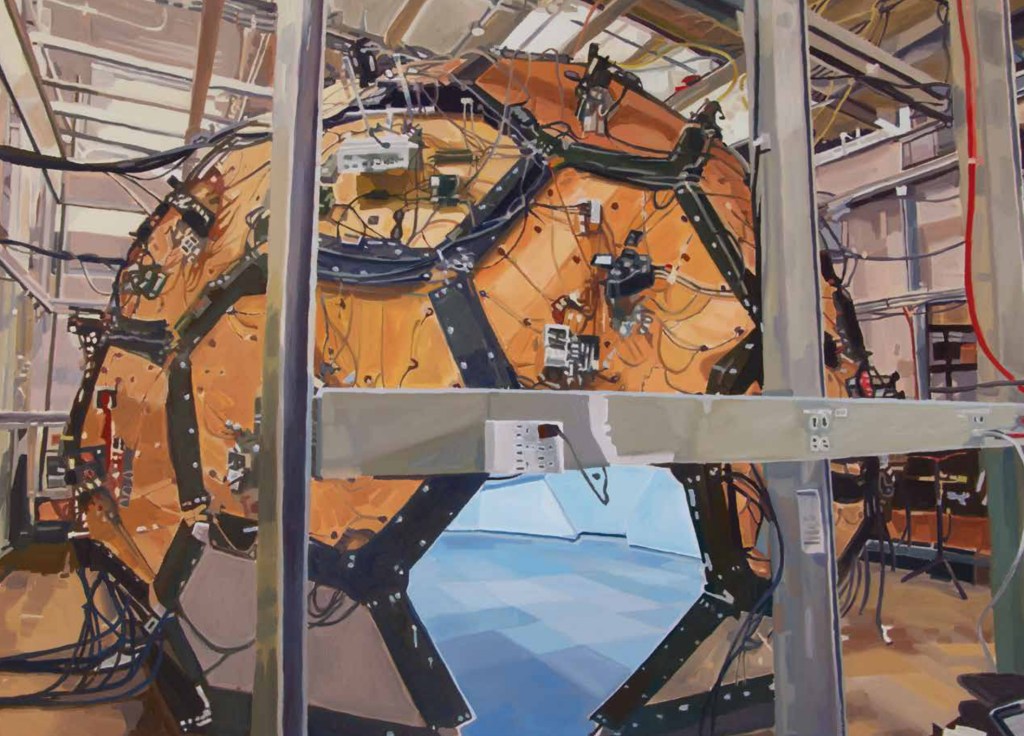
And yet, the vertiginous existential depths that these works seem to invoke may yet turn inside out and back-to-front: fear can become triumph, and pain may turn to pleasure. The powers that these technological advances circumscribe, which seem beyond control, are nonetheless creations of the species they plausibly threaten.
This is the final lesson of Martin’s sublime evocations: doom or salvation, our technology is fundamentally human.
 Cultural Criticism | Tom Lordan