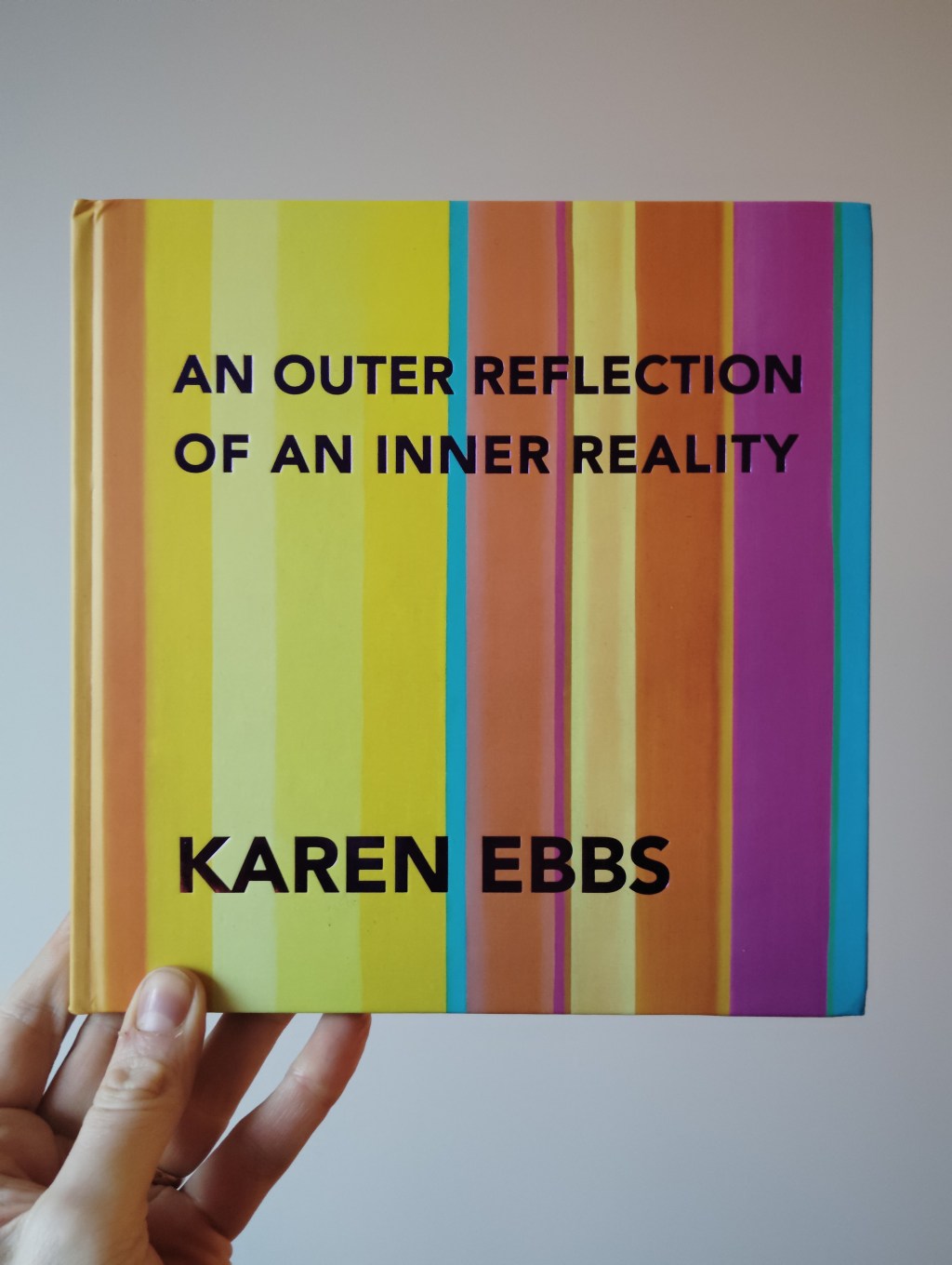
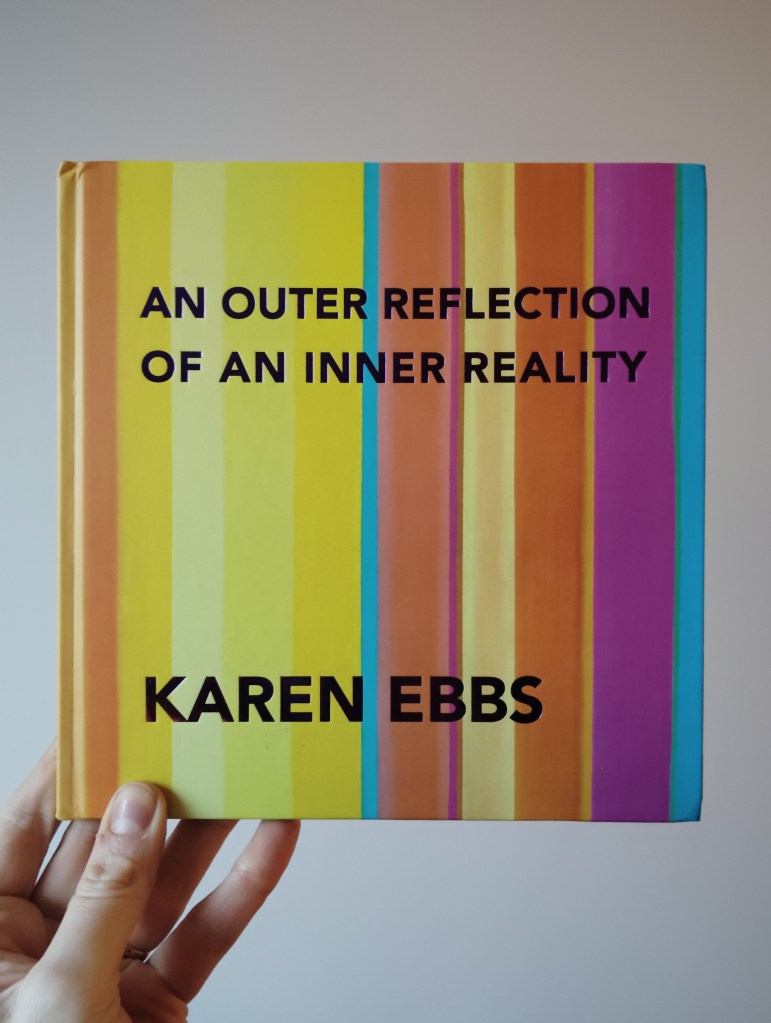
Published by Karen Ebbs & Dun Laoghaire Rathdown County Council
2025
PORTALS OF COLOUR: ON THE IMMERSIVE PRACTICE OF KAREN EBBS
Motivated by a deeply felt and idiosyncratic sensitivity to chromatic quality, colour
is at the centre of Karen Ebb’s practice.
Colour, of course, surrounds us. Integral to our visual experience, it is not just a layer inhabiting our perceptual awareness, it is a psychological texture we use to interpret our surroundings, and a property of the mechanical effects of light. The phenomenon of colour circulates between subjective and objective poles, or between self and world – studies of colour vary from intimate accounts of the feelings that colour provokes, to research papers detailing laboratory measurements of wavelength.
This mobility of colour – its status as an object of enquiry belonging to several disciplines at once – is evident across the 17th and 18th centuries: Isaac Newton, in his landmark treatise Opticks, declared that the “science of colour” needed to be “truly mathematical,” leading to the wavelength theory of light, and his demonstration of the chromatic spectrum via prism experiments. The Romantic poet and polymath Johann Wolfgang von Goethe denounced Newton, arguing that his treatise willfully ignored both the empirical aesthetic experience and psychological impact of colour. Less than a decade later, the German philosopher Arthur Schopenhauer reprimanded Goethe for omitting the physiology of the eye in his treatment, further stratifying the debate. As these overlapping interventions attest to, the character of colour is a transdisciplinary focus: as a purely personal sensation, a mathematisable content, a behavioural stimulus, and a physiological product, colour is the mutual index of a range of scientific and poetic approaches.
The artist Karen Ebbs is highly sensitive to the disciplinary unboundedness of colour, its oblique access to several registers of meaning making, and in An Outer Reflection Of An Inner Reality, she develops this plasticity of colour into a series of largescale manifolds. That is, colour takes centre-stage as both medium and subject of an ambitious sequence of new work.
Ebbs’ practice falls into the category of abstract painting – a broad category, admittedly. Owing to the influence of the late American modernists in the 20th century, this genre is often split into two subsets: colour fields and action painting. The former typically applies to canvases that feature large, untrammelled planes of colour, invoking meditative silence and themes of transcendence and the absolute, as in the works of Mark Rothko and Ad Rheinhardt. Action painting, on the other hand, is dynamic, gestural and emphasises the spontaneity of creation. An action painting is not “a picture,” in the words of the art critic Harold Rosenberg, “but an event.”
Karen Ebbs’ work speaks to both of these conventions, but the tendrils of her style also reach in other directions. Perhaps the most important touchstone is early European spiritual abstraction, like the art of Hilma af Klint and Georgia Houghton. For these artists, undergoing a stratospheric renewal of interest in the last 10 years, the operations on their canvases were visual pathways into the mystical core at the heart of reality; an idiosyncratic blend of occultism, theosophy, religious canon, botany and early microbiology. Artists like af Klint and Houghton sought to bring their audiences on a journey, usually across a series of paintings, to reveal an impenetrable truth about the order of the cosmos. Houghton, for instance, trained as a medium and interpreted her work as thanatographic messages, designed “to grasp the hidden mysteries beyond the veil.”
For Ebbs, her underlying devotional object is colour, which, in these new works, takes on the mantle of a unifying, universal force.
In the exhibition’s first paintings, Simply Put, Life Is Complex and Once A Day, Find Yourself Lost, substantial, self-contained shapes command the canvas. In the former, curvilinear contours delimit the figures – several seem to have an almost textile quality, as though cloth-bound, or covered in fabric. In the latter, right-angles and straight-edged frames populate the surface of the painting, while the rudimentary outline of a face haunts the background. Though formally distinct – freeform versus rectilinear, impersonal versus anthropic – these paintings form a pair because they render visible a world of discrete, medium-scaled objects. Next to them, the paintings A World Beyond Words and In Flux are a radical step forward, speaking to the macro- and micro-cosmic. Constellations emerge like blossoming forms in A World Beyond Words; a vibrant, celestial geometry coming into luminous presence. In Flux, at the opposite end of the scale, is animated by microbiological membranes, cells, and filaments, structures that appear to stretch, dilate, and breathe within a hidden interiority. From above and below, then, we are led to The Shape of Motion, a crucial milestone along Ebbs’ journey into colour. Totally dissimilar from its precedents, this painting features the representation of a recognisable space, a room, composed of walls, a floor, and an arched ceiling. The artist’s instinct for abstraction materialises in the ribbon figures that wander weightlessly through the space, casting shadows against the three-dimensional surfaces.
As with all spiritual journeys, the further we go, the deeper we get. From this high vantage point of representationalism, we plummet into the deepest abstract source: pure colour bands, rendered in Ebbs’ Vibrations Of Light series, speed across our vision.
Here we witness another important touchstone for Ebbs’ work, belonging to 20th century abstraction: the Op Art movement, emblematised by artists like Bridget Riley or Julian Stanczak. Pivotal to this movement was MOMA’s Responsive Eye exhibition in 1965. According to the institution’s press release, the exhibition contained “125 paintings and constructions by about 75 artists from some ten countries, documenting a widespread and powerful new direction in contemporary art.” In the accompanying catalogue, art historian William C. Seitz wrote that “[c]arefully controlled static images have the power to elicit subjective responses that range from a quiet demand on the eyes to distinguish almost invisible colour and shape differences to arresting combinations that cause vision to react with spasmodic afterimages.” The second fork of this principle clearly applies to Ebb’s trio of eye-watering banded colour intensities. Here Ebbs also makes deft use of what Michel-Eugène Chevreul, in his 1839 treatise De la loi du contraste simultané des couleurs, called “simultaneous contrast”: the tendency of adjacent hues to modify and intensify each other’s perceptual effect. In placing strident bands side by side, Ebbs demonstrates how colour is never static, but always relational, perpetually shifting according to its neighbour’s force.
Seitz, a key interlocutor in the period of late modernist American art, identified a subset within the Op Art movement as ‘colour imagists’, who share “a dependence on original and striking colour juxtaposition,” and “a reduction of shape-vocabulary to the simplest units and combinations,” which again resonates with Ebbs’ practice here.
After the small-scale variations and extemporisations, the final stage of Ebbs’ journey is the painting and sculpture installation, Wild & Untethered. Acting like a vestibule, or postscript, Wild & Untethered offers a moment of reflection to its visitors: an immersive, contemplative space, where the delicately embracing strands of magenta and fuchsia find their outward expression in a hanging aluminium sculpture. This room also represents the apotheosis of a certain artistic idea that Ebbs uses in this and previous exhibitions, namely her incorporation of mirrored surfaces. While in many contexts mirrors summon a Rabelaisian play of shifting impressions and proliferating perspectives, Ebbs turns them toward the opposite end: not excess, but concentration. Her mirrors serve instead as a visual analogue for the state she seeks to evoke: reflection understood in its most meditative sense.
This final room makes clear something crucial about the artist’s intent: Ebbs’ immersive, vibrant journey into colour is always anchored by an awareness of the viewer’s experience. Through inventive spatial design, the artist guides the exhibition’s visitors toward a particular receptive state. Clement Greenberg once remarked of Morris Louis that colour could become “a thing that opens and expands the picture plane.” The same could be said here, as Ebbs’ work operates as a portal: drawing the audience into an encounter, experiencing the phenomenon of colour afresh.
 Cultural Criticism | Tom Lordan