Published by the Visual Artist’s Newsheet
September 2026
Curated by Rain
TOM LORDAN INTERVIEWS EAMON COLMAN ABOUT HIS LATEST PAINTINGS.
Tom Lordan: Can you discuss your new body of work, recently shown at Solomon Fine Art?
Eamon Colman: I teach at Artform in Dunmore East, and through that, I was given the opportunity to become artist-in-residence at Mount Congreve Gardens in Waterford. They’re magnificent gardens, and home to Ireland’s largest collection of mature magnolia trees. Whenever I paint my surroundings, I begin by walking them. Nine times out of ten, I take notes as I walk and make drawings. Sometimes I walk with no intention of making images at all. This time, I brought a camera and took photographs. I became interested in the structure of the gardens. Photographing in black and white allowed me to focus on the shape, balance, and form, divorcing me from the immediate reality of the gardens.
There was perhaps an expectation that I would produce straightforward garden paintings, paint the pretty little flowers, but that was never what interested me. I wanted to paint the garden as it was absorbed by my imagination. The paintings are not landscapes – that is why I made them square. They are imaginative responses to the gardens rather than representations. The colour palette emerged directly from being there. The unusual blues, yellows, whites, and darker tones all have their origins in the experience of moving through the landscape and allowing it to work on me. I worked mainly in acrylic with highly pigmented colour, though there are organic materials mixed into some of the paintings as well.
TL: The exhibition title, ‘Curated by Rain’, is particularly evocative. Where did it come from?
EC: During the residency I became fascinated by the Peach House at Mount Congreve, which was used for growing and ripening peaches. The building was rough, derelict – water stains everywhere. I liked the idea of placing the paintings against this backdrop of decay. As we were installing a small exhibition there, it started to rain, and we realised we would have to move the paintings because water was beginning to come in. Somebody remarked that the show had been “curated by rain”, and I loved that phrase and used it for my subsequent exhibition at Solomon Fine Art in May. It also seemed to capture something essential about the work – those fleeting encounters, a particular quality or arrangement glimpsed while walking through the gardens and then gone again. The paintings are like attempts to hold onto those moments.
TL: Looking at the exhibition, I was struck by the titles as much as the paintings. They have a poetic quality.
EC: Poetry has always been important to me. It’s probably one of my main addictions in life. I came of age at a time when titling paintings was sometimes regarded as a bit passé, but I always thought that was a cop-out. Titles are really important to me, almost as important as the paintings themselves. They’re not descriptions – they’re part of the work.
TL: There seems to be an interesting tension in the work between abstraction and landscape.
EC: Back in the 1980s, I made the decision that I would never paint a human figure again. Up until then, I had been quite a serious figurative painter, but I felt we had become too obsessed with ourselves and weren’t paying enough attention to the minutiae of the natural world. From there, I gradually moved away from figurative painting, through landscape, and towards abstraction. What interests me now is whether abstraction can reveal something of those experiences of nature. That’s where the colour comes from; there’s a persistent idea that Ireland is somehow lacking in colour, but when you walk through the landscape, the opposite is true. The colours can be extraordinary – fields covered in yellow dandelions, for example. Traditional landscape painting often downplays that vibrancy.
I take care to layer and glaze colour. I make a milk-glue medium and use it as a transparent wash between each layer, so the paintings build up slowly. Most of the paintings in the exhibition were started about three years ago. A lot of my work takes time – I try to bring the paintings on their own journey of discovery. My hope is that this informs the audience’s experience. When someone stands in front of the work, I’m inviting them to bring their own imagination to what they are looking at. I don’t want to dictate meaning; I want to create a playful space where the viewer can participate.
TL: Where do you see this work leading next?
EC: Increasingly, I’m thinking about scaling these works up. Most people spend less than a minute with a painting, but I want to produce something big, one huge mother of a painting, because scale changes the relationship between the viewer and the work. A very large painting dictates the terms of engagement – it slows everything down.
Tom Lordan is a writer and art critic, motivated by contemporary European philosophy and its historical inheritance.
tomlordan.com
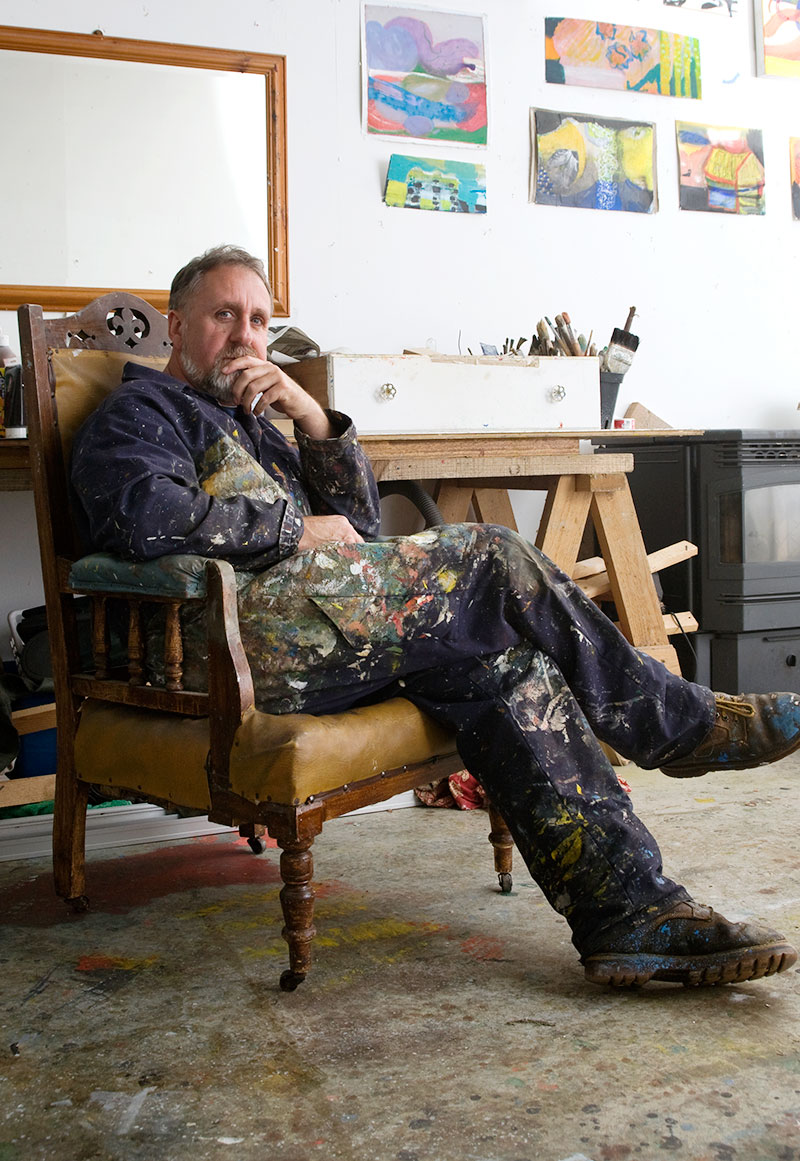
Eamon Colman is an artist who lives in the hills of northeast County Kilkenny.
eamoncolman.com
Eamon’s solo exhibition, ‘Curated by Rain’, ran at Solomon Fine Art from 28 May to 20 June 2026.
solomonfineart.ie

