September 2026
Illness, both chronic and mortal, has emerged as a recurring theme at this year’s Dublin Fringe Festival, appearing in several productions. It is hardly surprising. We live in the aftermath of a global pandemic, which haunts us all the more as we try to suppress its memory.
British philosopher Havi Carel’s 2016 book, the Phenomenology of Illness, distinguishes between the objective body, which medical science diagnoses and treats, and the lived body, through which we inhabit the world. For Carel, “disease” affects the former, whereas “illness” is the exclusive terrain of the latter.
The distinction is crucial: the person who falls ill (and is it not strange that we use the same verb for uncontrollable romance – to fall in love?) is not merely a biological organism but a whole way of being. While doctors discuss procedures and outcomes with the practical matter-of-factness of car mechanics, the object under discussion is your body: the basis of your most intimate reality – the thing your mother birthed and your soul pulses excruciatingly within.
It is this contradictory experience of illness, narrated from a deeply personal perspective, that Saving for a Helicopter seeks to explore. The production moves eloquently between these contrasting registers, from mundane, clinical realities to intense reckonings of mortality, shame, and grief.
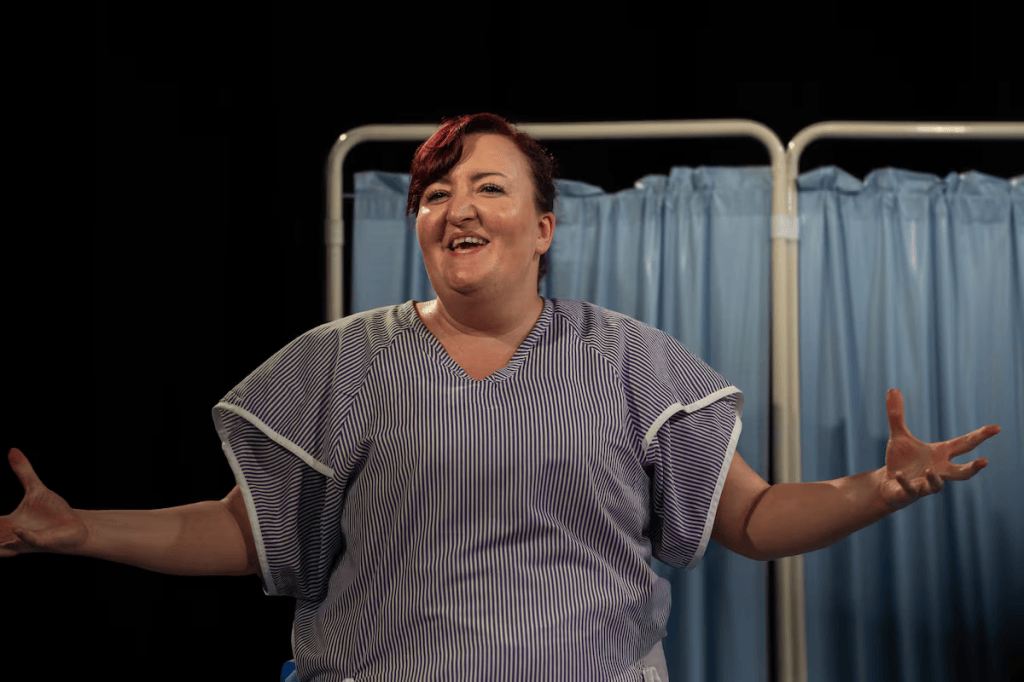
Everything hinges on Letterkenny’s Gráinne Curistan, the work’s writer and sole performer, and she rises magnificently to the challenge. Her performance is powerful and remarkably dexterous, carrying the audience through a series of linked anecdotes and emotional hairpin turns with compelling ease.
The play’s structure deftly interweaves two Gráinnes: the adult, confronting a diagnosis of a hereditary kidney condition that has threatened her life since childhood, and the child, innocently observing her father’s struggle with the same illness, including a transplant and his eventual death in Beaumont Hospital.
Over the course of 60 minutes, Curistan delivers a bravura performance, achieving poignancy and humour in equal doses.

